



Stephen's situation
Stephen is 74 and has two adult children. He plans to leave his home and the remainder of his estate equally to them.
Stephen invested in a portfolio of investments listed on the Alternative Investment Market (AIM) six years ago as part of his IHT planning. From 6 April 2026, qualifying shares admitted to trading on AIM receive BR at 50%. He asks whether moving the portfolio into unquoted companies could allow the investment to qualify for relief at 100%.
Stephen has substantial liquid assets outside the portfolio and does not expect to need the £300,000 in the short term. He understands that unquoted investments involve higher capital and liquidity risks.
His estate is currently worth approximately £1.25 million:

The adviser's recommendation
Stephen’s adviser reviews his financial position, expected expenditure, need for accessible capital, investment horizon, capacity for loss and attitude to risk. The adviser also obtains specialist tax advice on whether reinvesting the identifiable AIM sale proceeds would satisfy the replacement-property conditions.
Under those provisions, a new unquoted investment should not be assumed to receive relief at 100% immediately. Where property qualifying for relief at 50% is replaced by property that would otherwise qualify at 100%, the relief available before the new property has completed its own two-year ownership period is limited to the amount that would have been available without the replacement.
The adviser recommends selling the £300,000 AIM portfolio and reinvesting the identifiable proceeds in shares in unquoted trading companies expected to qualify for BR. During the first two years, the illustration therefore assumes relief remains limited to £150,000. Once Stephen has held the new shares for two years, they could qualify for relief at 100% in their own right, subject to the available 100% relief allowance and all other qualifying conditions being met at the relevant transfer.

Subject to replacement-property conditions, the available 100% relief allowance and all other qualifying conditions.
A note on this scenario
This hypothetical scenario is designed to help advisers think through how this type of planning might apply in practice. Whether it would suit a client will depend on their full financial circumstances, objectives, needs, capacity for loss and attitude to risk, along with the features, risks, charges and tax treatment of any investment being considered. Any recommendation would need to be made by the client’s financial adviser following a full suitability assessment.
This scenario is for illustrative purposes only and does not constitute investment, pension, tax, financial or legal advice. Actual outcomes will depend on investment performance, charges, the client’s circumstances and the tax legislation in force at the relevant time.
What it could mean in numbers
An illustration of Stephen’s inheritance tax position before and after reinvesting his £300,000 AIM portfolio in unquoted shares.
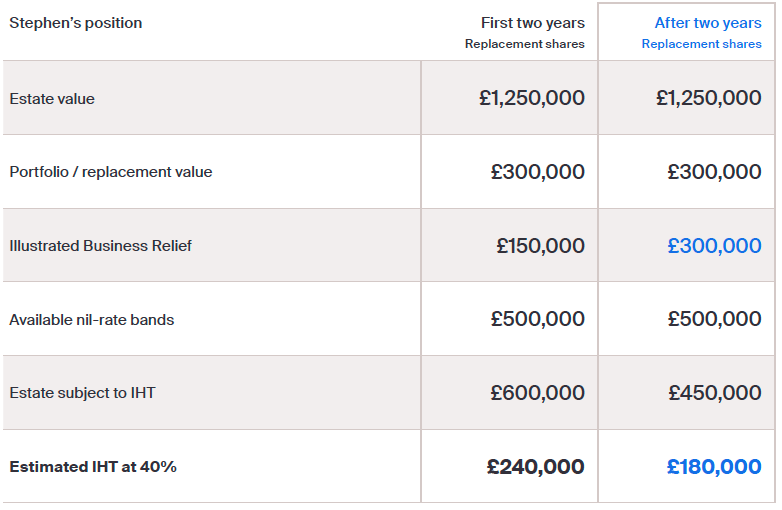
No immediate increase in relief is assumed: during the first two years, replacement-property relief remains limited to the amount available on the original AIM portfolio.
Illustrative assumptions
- Stephen’s estate remains worth £1.25 million and his full £325,000 nil-rate band and £175,000 residence nil-rate band are available.
- The AIM portfolio qualifies for BR at 50%, and the unquoted £300,000 replacement investment is assumed to remain unchanged throughout, with no growth or fall in value. In practice, the value will fluctuate, and any change would alter both the value of Stephen’s estate and the IHT figures shown.
- Stephen has not used any of the £2.5 million combined allowance for property qualifying for 100% Agricultural Property Relief (APR) or Business Relief (BR).
- The identifiable AIM sale proceeds are reinvested and the replacement-property conditions are met.
- No transferable allowances, debts, gifts, charitable legacies or other exemptions and reliefs are included.
- Fees and charges are excluded. In practice, the investment would be subject to fees and charges, which would reduce the amount invested and therefore the potential IHT savings shown.
- The standard IHT rate of 40% applies.
Why the adviser recommends this approach
The recommendation reflects Stephen’s objective of improving the potential IHT treatment of the £300,000 portfolio while retaining ownership of the investment. His £450,000 of cash and conventional investments reduces his reliance on the unquoted shares, while his financial position and investment horizon give him the capacity to
accept the higher capital and liquidity risks involved.
The recommendation also makes the transition clear from the outset. The replacement-property provisions may preserve relief at the 50% rate during the first two years, while relief at 100% would depend on the new shares completing their own ownership period and satisfying the qualifying conditions at the relevant transfer. On the stated assumptions, this could reduce the estimated IHT liability from £240,000 to £180,000 after two years.
Potential reduction after two years

The new shares could qualify for 100% Business Relief after their own two-year ownership period, subject to the available allowance and all qualifying conditions.
Key risks and considerations
- Capital is at risk. The value of the unquoted shares may fall as well as rise, and Stephen may receive back less than the amount invested. Smaller unquoted companies generally involve greater risk.
- Liquidity is not guaranteed. Shares in unquoted companies can be difficult to sell, so access to capital may be delayed and the amount realised may be lower than expected.
- Business Relief is not guaranteed. The rate and availability of relief depend on the investment satisfying the qualifying conditions, Stephen’s individual circumstances and available allowance, and the legislation in force at the relevant transfer, which may be subject to change, and such changes may be retrospective.
- The replacement-property provisions are technical. Before the new shares complete their own two-year ownership period, relief may be limited to the amount available on the former AIM portfolio. Specialist tax advice is essential before any sale or reinvestment.
- The residence nil-rate band depends on the circumstances. The illustration assumes Stephen’s home passes to direct descendants and that his estate satisfies the relevant conditions.
Important Notice
For professional advisers only.
This article is for information purposes only and does not constitute investment, tax, financial or legal advice. It does not constitute an offer to buy or sell an investment or solicit any such invitation.
The information is believed to be accurate at the date of publication, but no representation or warranty, stated or implied, is made or given by any person as to its accuracy or completeness and no responsibility or liability is accepted for any such information or opinion. Tax treatment depends on individual circumstances, and tax rules may change.
Issued by Beringea LLP of Charter House, 55 Drury Lane, London, England WC2B 5SQ. Registered in England and Wales under number OC342919. Authorised and regulated by the Financial Conduct Authority under number 496358.


