



Marcus's situation
Marcus is 70 and has been retired for four years. He has a defined contribution pension and has already taken his available tax-free cash.
Marcus receives £30,000 a year from his State Pension and a small defined benefit pension. He also holds substantial cash savings outside his pension.
He would like to set aside £60,000 to help his two grandchildren with university costs and house deposits in around six years. He does not need immediate access to the money and has the capacity to accept the higher risks associated with investing in smaller companies.

The adviser's recommendation
Marcus’s adviser first considers the effect of the £60,000 withdrawal on his pension and wider retirement plan. After reviewing his income, expenditure, accessible savings and anticipated needs, the adviser concludes that the withdrawal would not compromise his ability to fund his retirement. The adviser then assesses whether a VCT investment is appropriate for Marcus’s six-year objective and his capacity to accept investment loss and limited liquidity.
The adviser recommends a two-part strategy, with the pension withdrawal and the VCT investment considered as separate suitability decisions:
1. Withdraw £60,000 from his pension
As Marcus has already taken his available tax-free cash, the full withdrawal is taxable. Based on his existing annual income of £30,000, the first £20,270 of the withdrawal falls within the basic-rate band and is taxed at 20%, while the remaining £39,730 is taxed at 40%. The withdrawal therefore gives rise to £19,946 of income tax and leaves net proceeds of £40,054.
2. Add £19,946 from his savings
To avoid reducing the amount set aside for his grandchildren, Marcus adds £19,946 from his existing savings to the £40,054 received from his pension, giving him £60,000 to invest.
3. Invest £60,000 in new VCT shares
For shares issued during the 2026-27 tax year, relief is available at 20% of the amount subscribed. Subject to the qualifying conditions and Marcus having sufficient income tax liability, the investment could therefore provide income tax relief of £12,000.
Marcus’s adviser recommends gifting any dividends received from the VCT to his grandchildren in the meantime, using gifts from regular income.
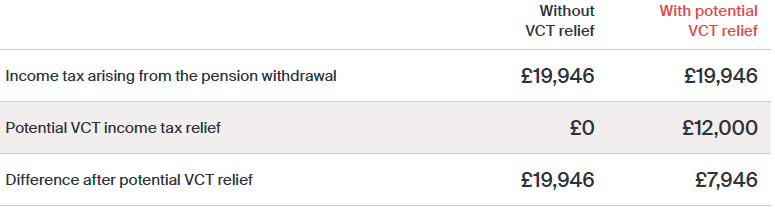
The pension withdrawal remains fully taxable and still gives rise to £19,946 of income tax. The potential VCT relief is claimed separately against Marcus’s overall income tax liability and could reduce that liability by £12,000. Comparing only the amounts illustrated in this scenario leaves a difference of £7,946.

A note on this scenario
This hypothetical scenario is designed to help advisers think through how this type of planning might apply in practice. Whether it would suit a client will depend on their full financial circumstances, objectives, needs, capacity for loss and attitude to risk, along with the features, risks, charges and tax treatment of any investment being considered. Any recommendation would need to be made by the client’s financial adviser following a full suitability assessment.
This scenario is for illustrative purposes only and does not constitute investment, pension, tax, financial or legal advice. Actual outcomes will depend on investment performance, charges, the client’s circumstances and the tax legislation in force at the relevant time.
What it could mean in numbers
An illustration of how Marcus funds a £60,000 VCT investment and how potential VCT relief compares with the tax arising from his pension withdrawal.
How the £60,000 VCT investment is funded
1. Pension proceeds after tax

2. Adding savings to fund the investment

The potential £12,000 VCT income tax relief is claimed separately against Marcus’s overall income tax liability. It does not form part of the initial investment funding.
Illustrative assumptions
- Marcus is subject to the 2026-27 income tax rates and allowances for England, Wales and Northern Ireland and receives annual income of £30,000 before the withdrawal.
- The full £60,000 pension withdrawal is taxable and the stated income tax bands and rates apply.
- Marcus has enough savings to supplement the net pension proceeds without affecting his anticipated needs.
- He invests £60,000 in qualifying newly issued VCT shares and has sufficient income tax liability to claim the relief in full.
- He holds the VCT shares for at least five years in order to retain the upfront income tax relief.
- Fees, charges, investment performance and other deductions or reliefs are excluded.
Why the adviser recommends this approach
The recommendation reflects Marcus’s objective of setting aside £60,000 for his grandchildren in around six years. His retirement income and accessible savings are sufficient for his anticipated needs, which means he does not expect to rely on the VCT investment during the intended holding period and has the capacity and is willing to accept the higher risks involved.
Although the figures are presented together, the pension withdrawal and the VCT investment remain separate recommendations. The withdrawal must be appropriate within Marcus’s retirement plan, while the investment must be suitable in its own right. On the stated assumptions, the £19,946 of tax arising from the withdrawal exceeds the potential VCT relief by £7,946.

Based on the stated assumptions. VCT income tax relief is subject to qualifying conditions and sufficient income tax liability.
Key risks and considerations
- Capital is at risk. The value of VCT shares may fall as well as rise, and Marcus may receive back less than the amount invested. VCTs invest in smaller companies, which generally involve greater risk.
- VCTs should be considered as a long-term investment. Disposing of shares within five years of issue will normally result in the initial income tax relief being withdrawn and having to be repaid.
- Income tax relief is not guaranteed. Tax treatment will depend on Marcus’s individual circumstances, including having sufficient income tax liability, the VCT maintaining its qualifying status and the legislation in force, which is subject to change, and such changes may retrospective.
- The pension withdrawal remains taxable. VCT relief is claimed separately against Marcus’s overall income tax liability and does not change the tax treatment of the withdrawal.
- VCT shares can be difficult to sell. They may trade at a discount to the net asset value, and a sale may take time or realise less than expected. Although many VCTs operate share buyback programmes, these are not guaranteed.
Important Notice
For professional advisers only.
This article is for information purposes only and does not constitute investment, tax, financial or legal advice. It does not constitute an offer to buy or sell an investment or solicit any such invitation.
The information is believed to be accurate at the date of publication, but no representation or warranty, stated or implied, is made or given by any person as to its accuracy or completeness and no responsibility or liability is accepted for any such information or opinion. Tax treatment depends on individual circumstances, and tax rules may change.
Issued by Beringea LLP of Charter House, 55 Drury Lane, London, England WC2B 5SQ. Registered in England and Wales under number OC342919. Authorised and regulated by the Financial Conduct Authority under number 496358.


